
Welcome to this week’s publication of the Market’s Compass Crypto Sweet Sixteen Study #244. The Study tracks the technical condition of sixteen of the larger market cap cryptocurrencies. Every week the Studies will highlight the technical changes of the 16 cryptocurrencies that I track as well as highlights on noteworthy moves in individual Cryptocurrencies and Indexes. Past publications including the Weekly ETF Studies can be accessed by paid subscribers via The Market’s Compass Substack Blog.
An explanation of my objective Individual Technical Rankings and Sweet Sixteen Total Technical Ranking go to www.themarketscompass.com. Then go to the MC’s Technical Indicators and select “crypto sweet 16”. What follows is a Cliff Notes version* of the full explanation…
*The technical ranking system is a quantitative approach that utilizes multiple technical considerations that include but are not limited to trend, momentum, measurements of accumulation/distribution and relative strength. The TR of each individual Cryptocurrency can range from 0 to 50. The Sweet Sixteen Total Technical Ranking or “SSTTR” is the sum of the sixteen individual TRs and can be viewed as an overbought / oversold indicator as well as a confirmation / non-confirmation indicator.
The Sweet Sixteen Total Technical Ranking fell for the third week in a row, down -18.60% to 245 after falling -23.12% the week before to 301 and was down -46.5% from 457.5 four weeks ago, which was the highest reading in the SSTTR since October of last year.
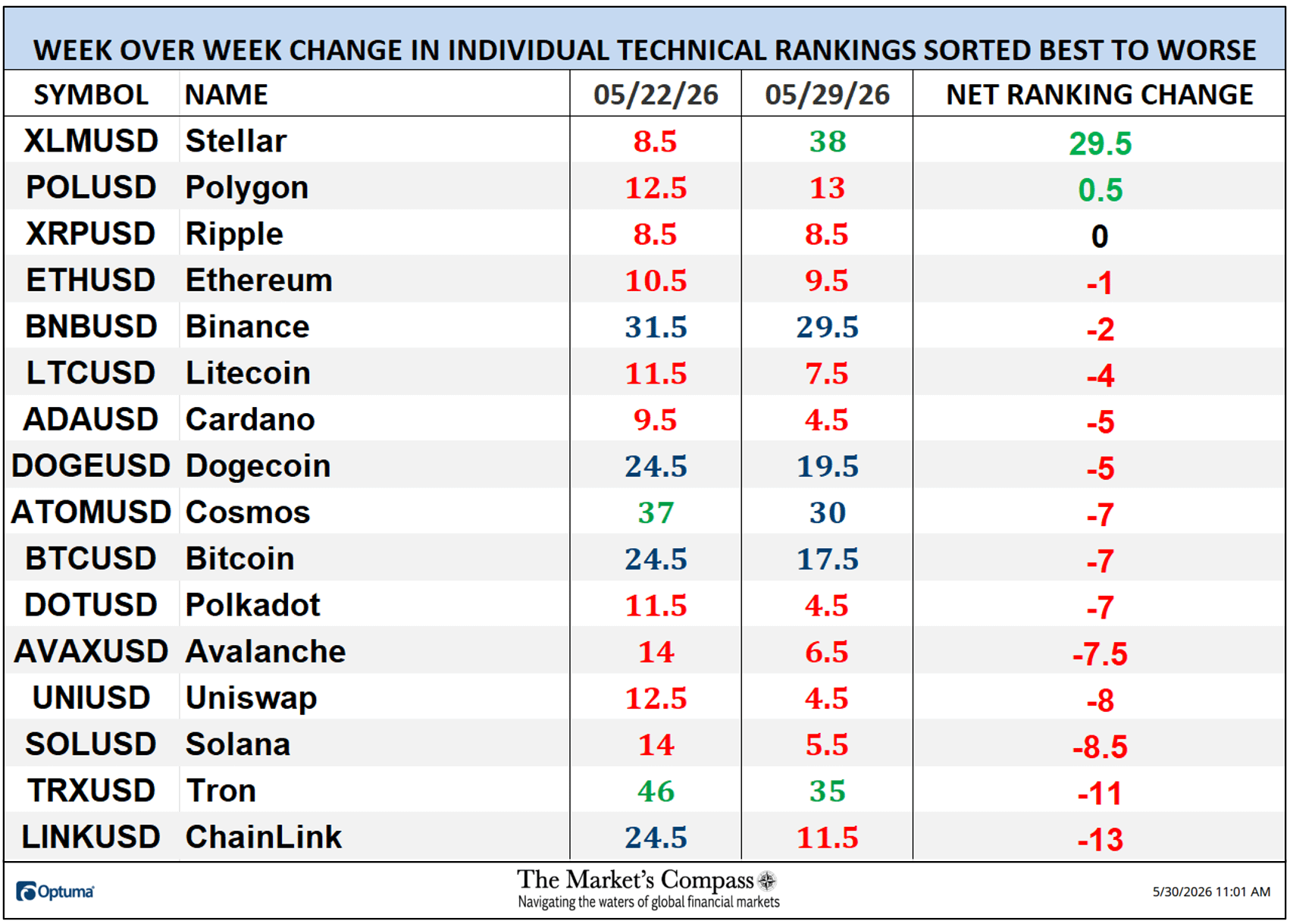
Last week only two of the Sweet Sixteen TRs gained ground, one was unchanged, and thirteen TRs fell. The standout TR gainer was Stellar (XLM). Two of the Crypto Currency TRs ended the week in the “green zone” (TRs between 35 and 50), four were in the “blue zone” (TRs between 15.5 and 34.5), and ten were in the “red zone” (TRs between 0 and 15). The previous week when there were two TRs in the “green zone”, four were in the “blue zone” and ten were in “red zone”. The Average TR loss on the week was -3.5, adding to the previous week’s Average TR loss of -5.66. If it were not for the TR gain of +29.5 in XLM the average TR loss would have been -5.7 (more on Stellar’s “monster” TR move and price rally later in today’s Study).
*The 13-Week Exponential Moving Average (EMA) lines smooths what can be “choppy” Technical Rankings and better defines trend. in the TRs. Changes in the EMA trends with follow-through are signals worthy of consideration.
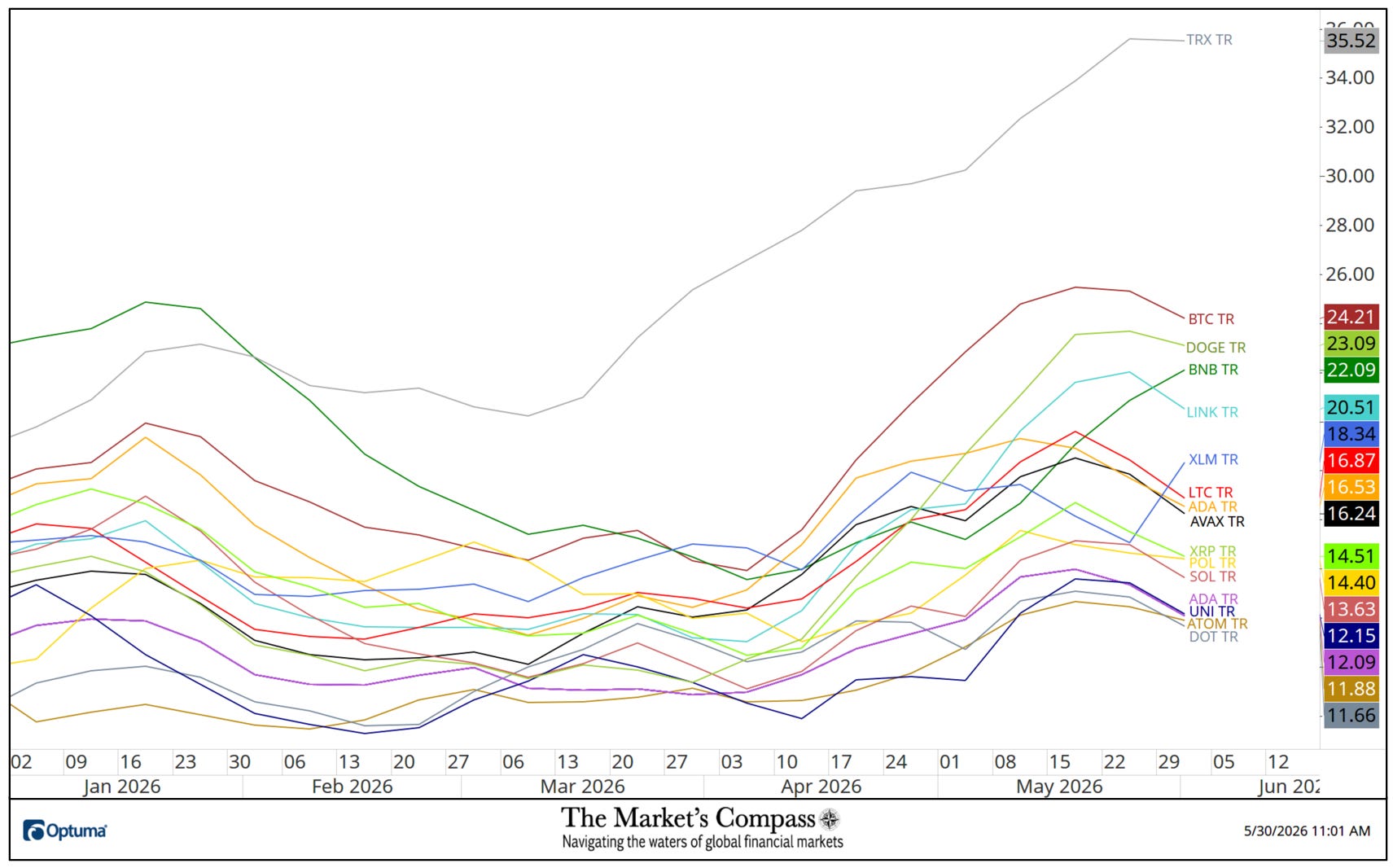
Tron’s (TRX) Technical Ranking 13-Week EMA trend continues to consistently outpace the Sweet Sixteen Crypto Currencies that I track in these pages despite last week’s slight slowing. Only Binance (BNB) registered a higher 13-Week EMA in January but contracted until it began to improve in early April. Bitcoin (BTC) has been a Technical Ranking 13-Week EMA leader since the start of the year but has begun to roll over. Dogecoin’s (DOGE) 13-Week EMA has accelerated since late March, but it too has begun to slow. Stellar’s (XLM) Technical Ranking, and in turn, its EMA was beginning to look concerning two weeks ago before last week’s sharp turn higher. The balance of the Sweet Sixteen 13-Week EMAs of TRs continue to trend lower.
The Relative Rotation Graph, commonly referred to as RRGs, was developed in 2004-2005 by Julius de Kempenaer. These charts are a unique visualization tool for relative strength analysis. Chartists can use RRGs to analyze the relative strength trends of several securities against a common benchmark, (in this case the CCi30 Index*) and against each other over any given period (in the case below, daily) over the past two weeks. The power of RRG is its ability to plot relative performance on one graph and show true rotation. All RRGs charts use four quadrants to define the four phases of a relative trend. The Optuma RRG charts rotates from Leading (in green) to Weakening (in yellow) to Lagging (in pink) to Improving (in blue) and back to Leading (in green). True rotations can be seen as securities move from one quadrant to the other over time. This is only a brief explanation of how to interpret RRG charts. To learn more, see the postscripts and links at the end of this Blog.
*The CCi30 Index is a registered trademark and was created and is maintained by an independent team of mathematicians, quants and fund managers lead by Igor Rivin. It is a rules-based index designed to objectively measure the overall growth, daily and long-term movement of the blockchain sector. It does so by indexing the 30 largest cryptocurrencies by market capitalization, excluding stable coins (more details can be found at CCi30.com).
The chart below has two weeks, or 14 days, of relative data points vs. the benchmark, deliniated by the dots or nodes. Not all of the Sweet Sixteen are plotted in this RRG Chart. I have done this for clarity purposes. Those which I believe are of higher technical interest remain.
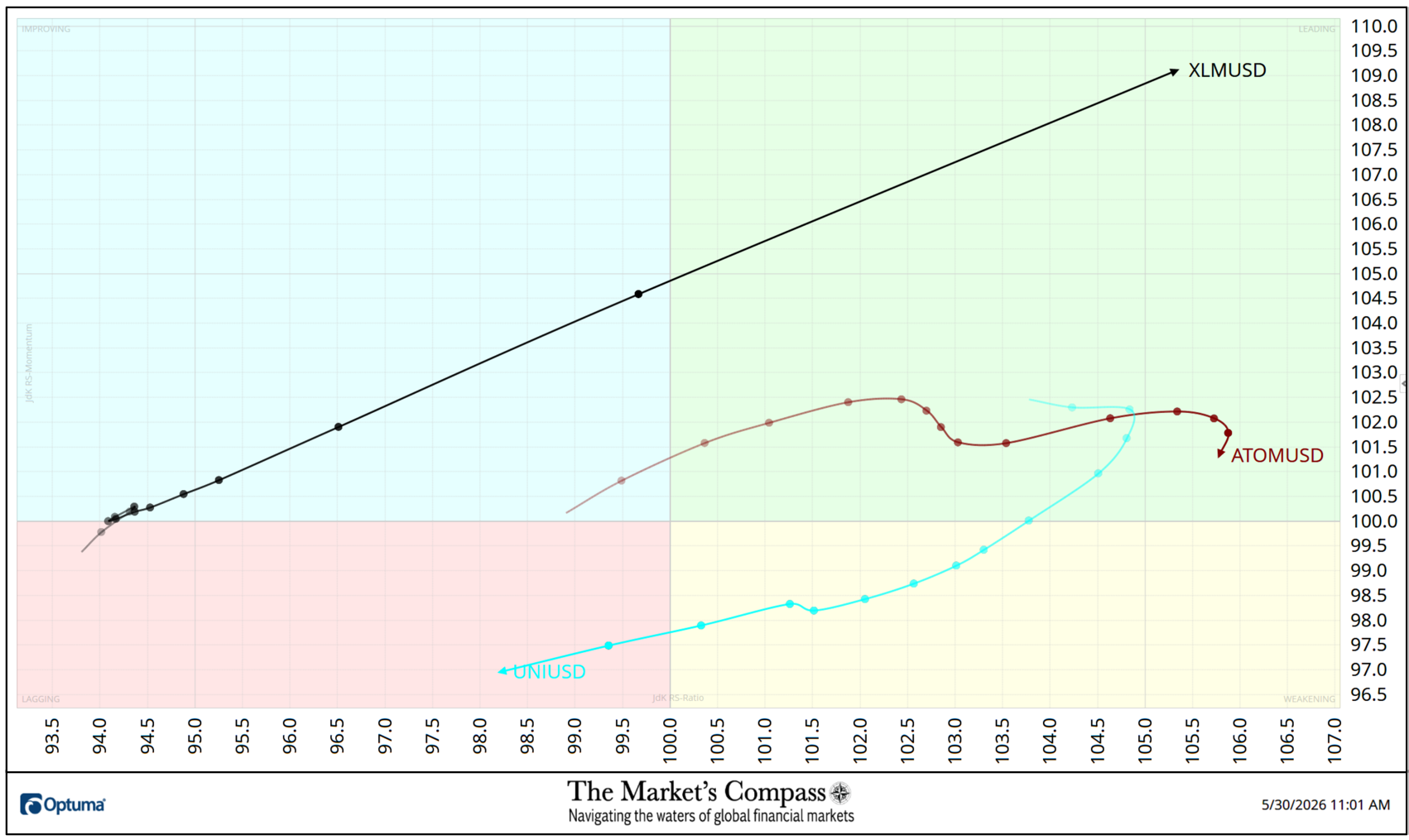
I normally stick to my technical analysis “knitting”, but I feel I must stray from my normal analysis and clarify what I referred to as the “monster” move in Stellar (XLM). Responding to reports of DTCC’s (Depository Trust & Clearing Corporation) announcement of a collaboration with the Stellar Development Foundation, XLM rallied more than 80% over the past seven days with the bulk of the move occurring since last Wednesday (more on that later in the Study). That price move drove XLM out of the Improving Quadrant into the Leading Quadrant exhibiting historically unmatched Relative Strength Momentum (as can be seen by the distance between the daily nodes since the middle of last week). Even though Cosmos (ATOM) has begun to roll over for the second time in the Leading Quadrant in the past two weeks it nonetheless still commanded the highest Relative Strength Ratio vs. the CCi30 Index at the end of last week at 105.78 (see the Tabulation Table below). A week ago, last Wednesday Uniswap (UNI) fell out of the Leading Quadrant into the Weakening Quadrant and gathered a pace at the end of last week displaying negative Relative Strength Momentum and fell into the Lagging Quadrant.
The “Tabulation Table” below marks the Relative Strength and Relative Strength Momentum readings of the Sweet Sixteen vs. the CCi30 Index at the end of last week and the end of the two preceding weeks. If there has been an improvement in either the Relative Strength Ratio or the Relative Strength Momentum reading since the end of the preceding week, I have highlighted it in green. If there has been a contraction in either it is highlighted in red and an unchanged reading in either will remain black. The color-coding system has served as a heat map over the past three weeks highlighting either the continued improvement, deterioration, or stasis vs. the benchmark CCi30 Index. The crypto currencies that are in the comments below the RRG chart are highlighted in blue.
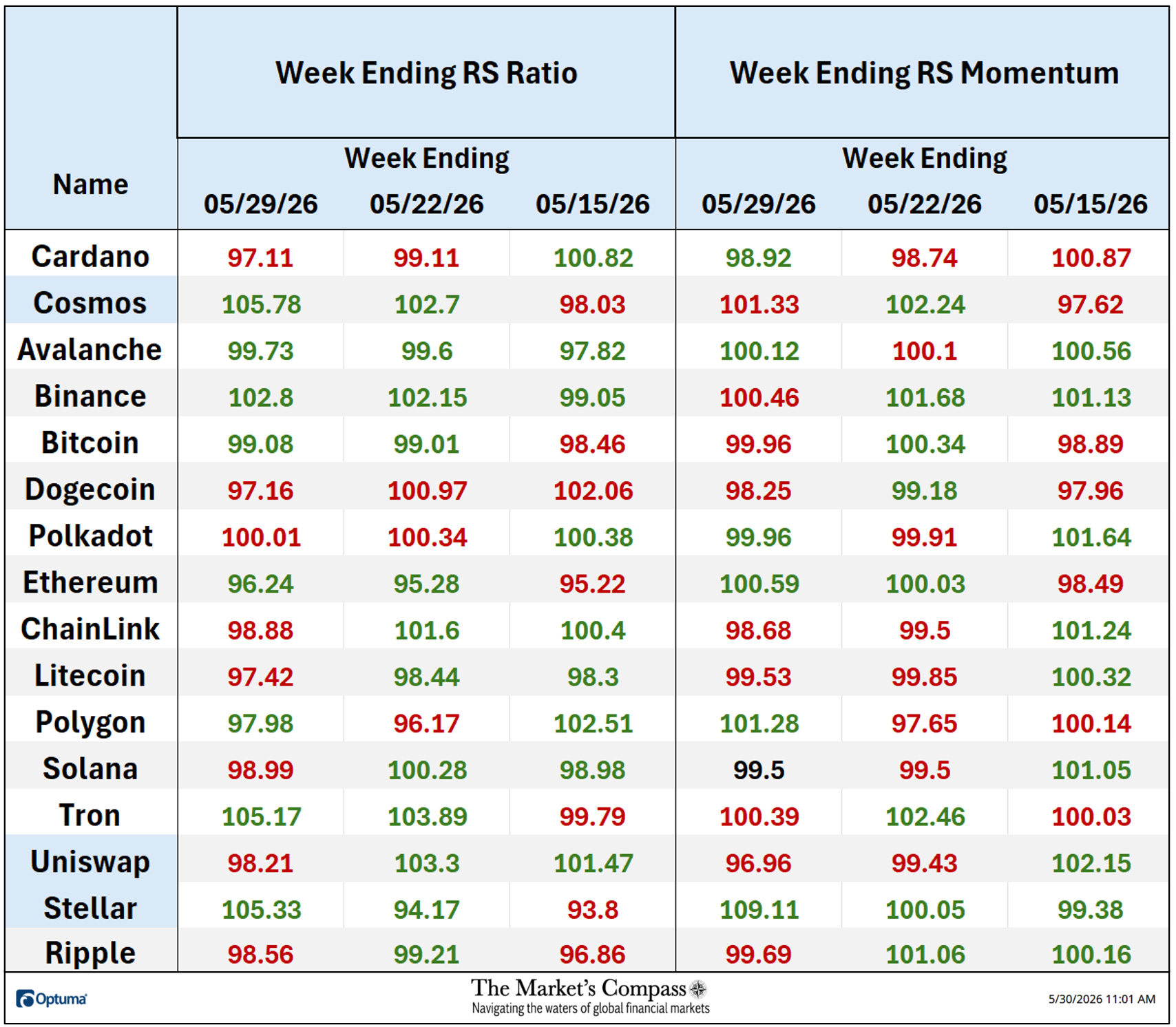
*Friday May 22nd to Friday May 29th
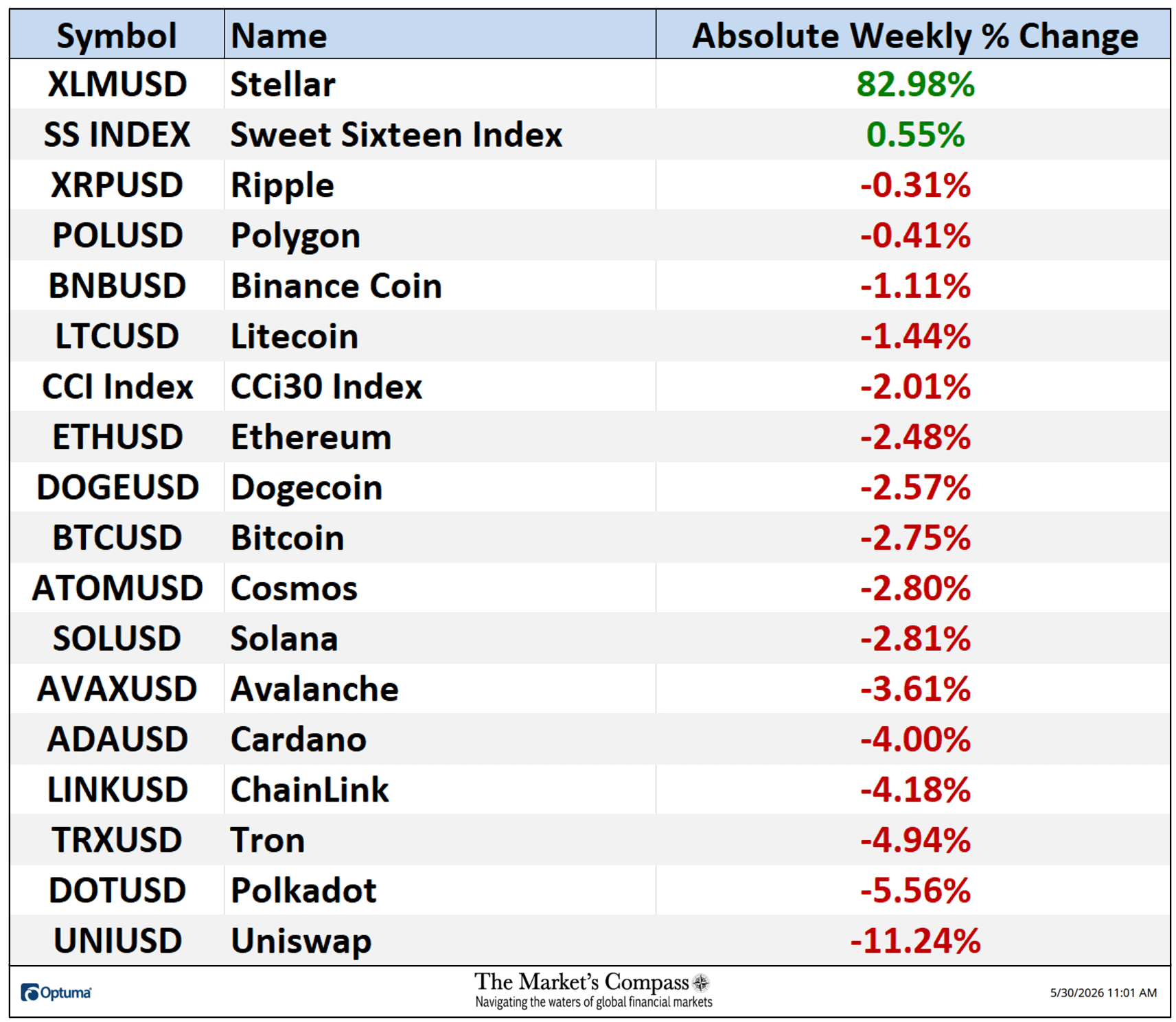
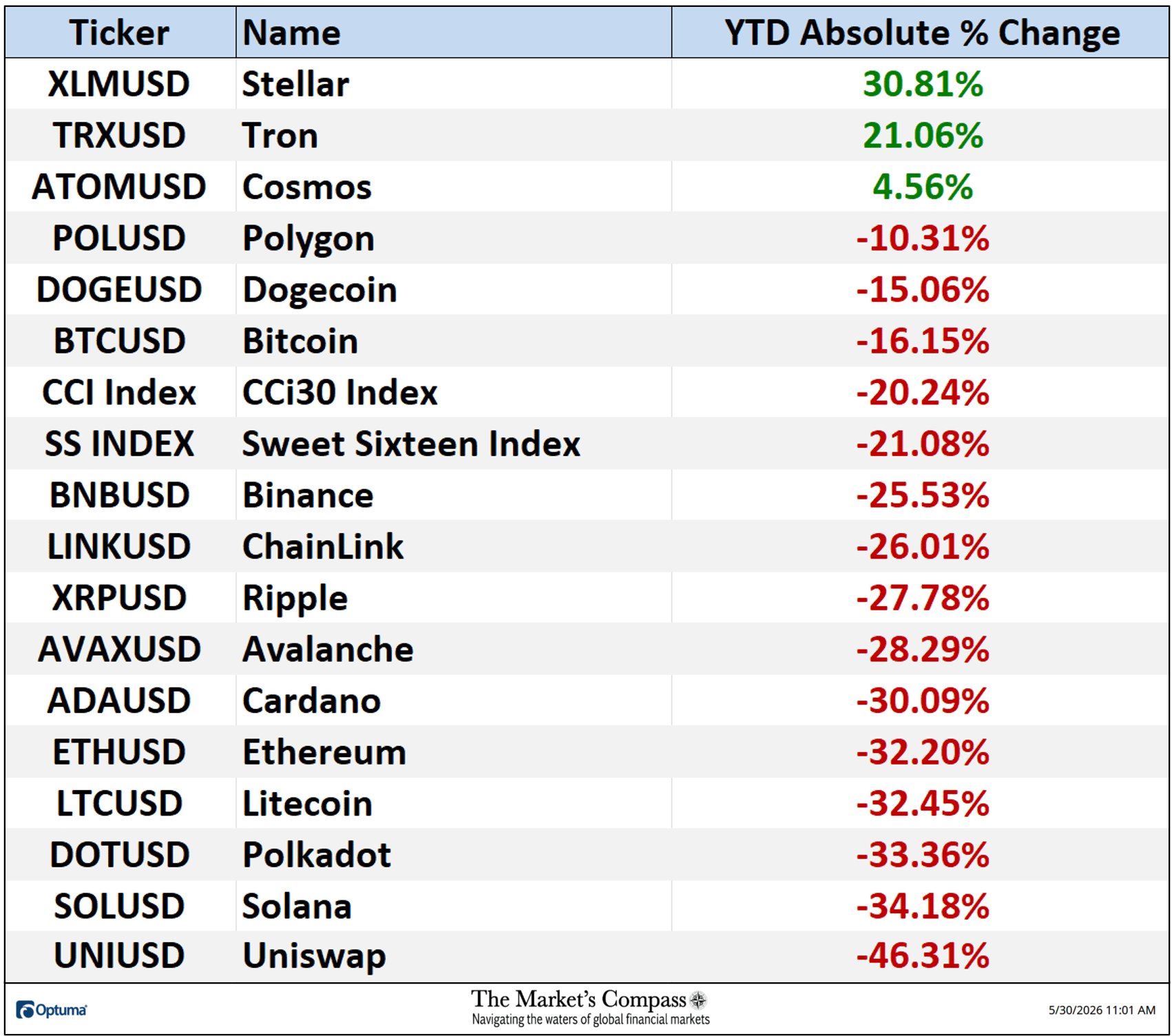
Over the past seven days only one of the Sweet Sixteen gained absolute ground and fifteen traded lower vs the previous week when two of the Sweet Sixteen gained absolute ground and fourteen traded lower. Last week the average absolute percentage gain was +2.05% (the average absolute loss would have been -3.35% if not for the +82.98% absolute gain in Stellar) The average percentage loss the week before was -4.50%. Both weekly average gains and losses exclude the two Indexes.
The Technical Condition Factors or TCFs are utilized in the calculation of the Individual Crypto Currencies Technical Rankings. What is shown in the excel panel below is the total TCFs of all sixteen TRs. A few TCFs carry more weight than the others, such as the Weekly Trend Factor and the Weekly Momentum Factor in compiling each individual TR of each of the 16 Cryptocurrencies. Because of that, the excel sheet below calculates each factor’s weekly reading as a percentage of the possible total.
A full explanation of my Technical Condition Factors go to www.themarketscompass.com. Then go to the MC’s Technical Indicators and select Crypto Sweet 16.
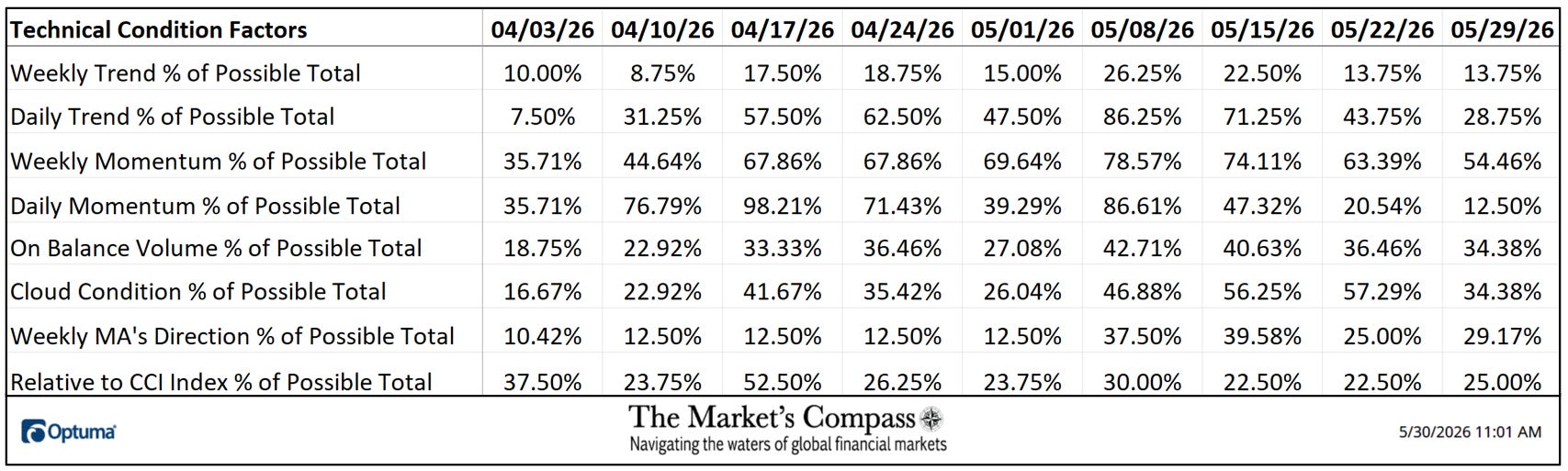
The Daily Momentum Technical Condition Factor or “DMTCF” fell again to an oversold reading of 12.50% or 14 out of a possible 112 from an almost overbought reading of 86.61% reading or 97 four weeks ago.
As a confirmation tool, if all eight TCFs improve on a week over week basis, more of the 16 Cryptocurrencies are improving internally on a technical basis, confirming a broader market move higher (think of an advance/decline calculation). Conversely, if more of the TCFs fall on a week over week basis, more of the “Cryptos” are deteriorating on a technical basis confirming the broader market move lower. At the end of last week five of the TCFs marked decreases, one was unchanged and two rose.
The “TSSTCF” Oscillator tallies the eight objective Technical Condition Factors into one overbought / oversold indicator that ranges between 0 and 8.
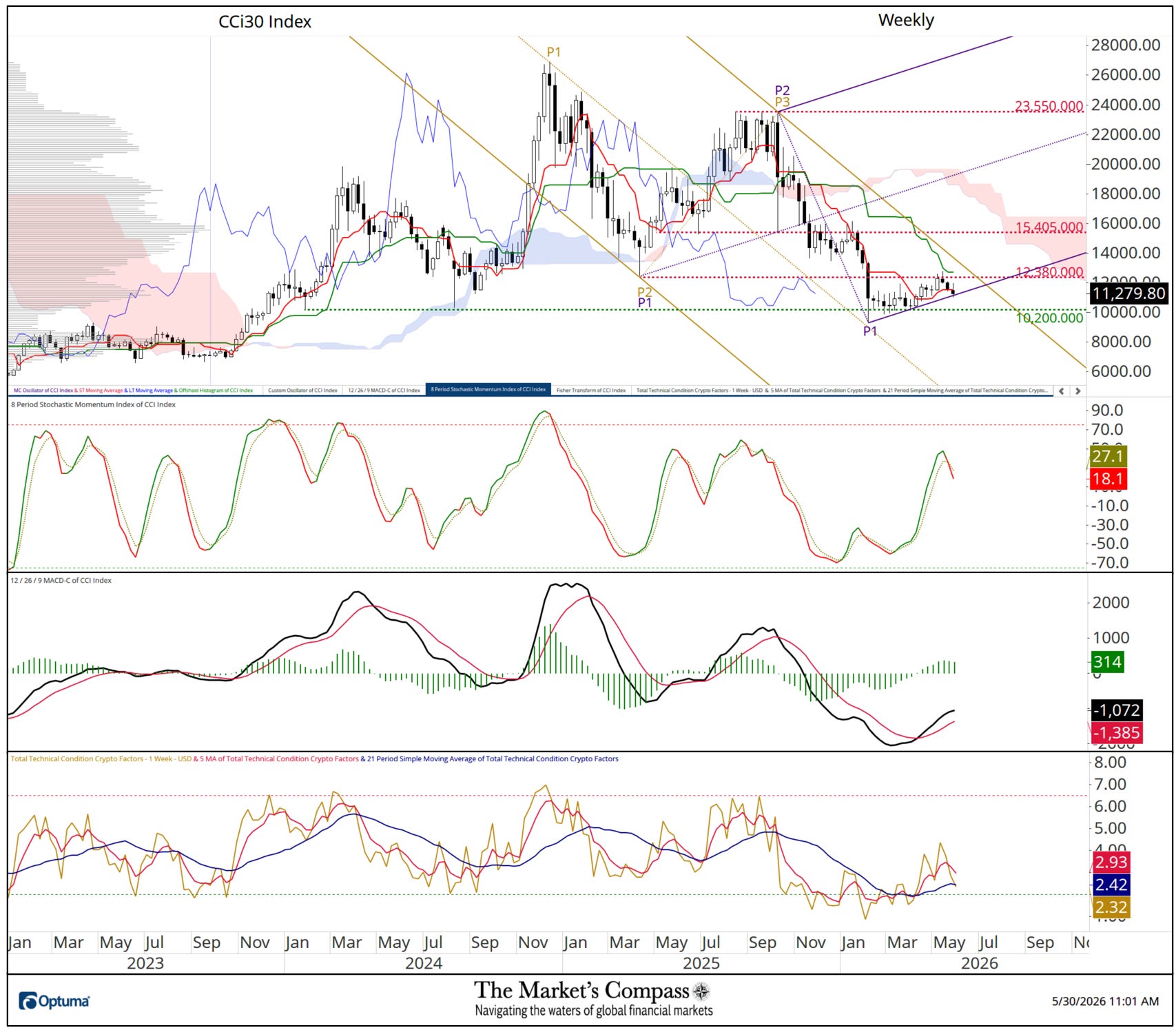
The sub-title to the Crypto Sweet Sixteen Study three weeks ago was “More Hurdles Ahead”. Those price hurdles remain in place and capped a continuation of the uptrend attempt in the Weekly chart. This week’s subtitle is “Hanging on By a Thread”. After being capped at the 12,380 level in the CCi30 Index the prices have returned to support at the Lower Parallel (solid violet line) of the shorter-term Standard Pitchfork (violet P1 through P3). The 8-Week Stochastic Momentum Index has rolled over through its signal line and has begun to track lower. Although MACD continues to climb away from oversold territory, its ascent is beginning to slow. The Total Technical Condition Crypto Factor Oscillator has fallen below both the now falling 5-Week Exponential Moving Average (red line) and has just edged below 21-Week Simple Moving Average (blue line). If the Lower Parallel of Pitchfork fails to support prices a quick test of price support at 10,200 is likely in the cards. Maybe the sub-title should be “Feet Don’t Fail Me Now”.
For readers who are unfamiliar with the technical terms or tools referred to in the comments on the technical condition of the CCi30 Index can avail themselves of a brief tutorial titled, Tools of Technical Analysis and the three part Andrews Pitchfork Series available on my website.
Charts are courtesy of Optuma whose charting software allows the Technical Rankings to be calculated and back tested.