
Welcome to this week’s publication of the Market’s Compass Crypto Sweet Sixteen Study #237. The Study tracks the technical condition of sixteen of the larger market cap cryptocurrencies. Every week the Studies will highlight the technical changes of the 16 cryptocurrencies that I track as well as highlights on noteworthy moves in individual Cryptocurrencies and Indexes. As always, paid subscribers will receive this week’s unabridged Market’s Compass Crypto Sweet Sixteen Study sent to their registered email Sundays. Past publications including the Weekly ETF Studies can be accessed by paid subscribers via The Market’s Compass Substack Blog.
An explanation of my objective Individual Technical Rankings and Sweet Sixteen Total Technical Ranking go to www.themarketscompass.com. Then go to the MC’s Technical Indicators and select “crypto sweet 16”. What follows is a Cliff Notes version* of the full explanation…
*The technical ranking system is a quantitative approach that utilizes multiple technical considerations that include but are not limited to trend, momentum, measurements of accumulation/distribution and relative strength. The TR of each individual Cryptocurrency can range from 0 to 50. The Sweet Sixteen Total Technical Ranking or “SSTTR” is the sum of the sixteen individual TRs and can be viewed as an overbought / oversold indicator as well as a confirmation / non-confirmation indicator.
At the end of last week, the Sweet Sixteen Total Technical Ranking rose sharply jumping +41.98% to the upper end of its recent range to 265.5 from a higher low of 187, which was a rise from 158 three weeks ago.
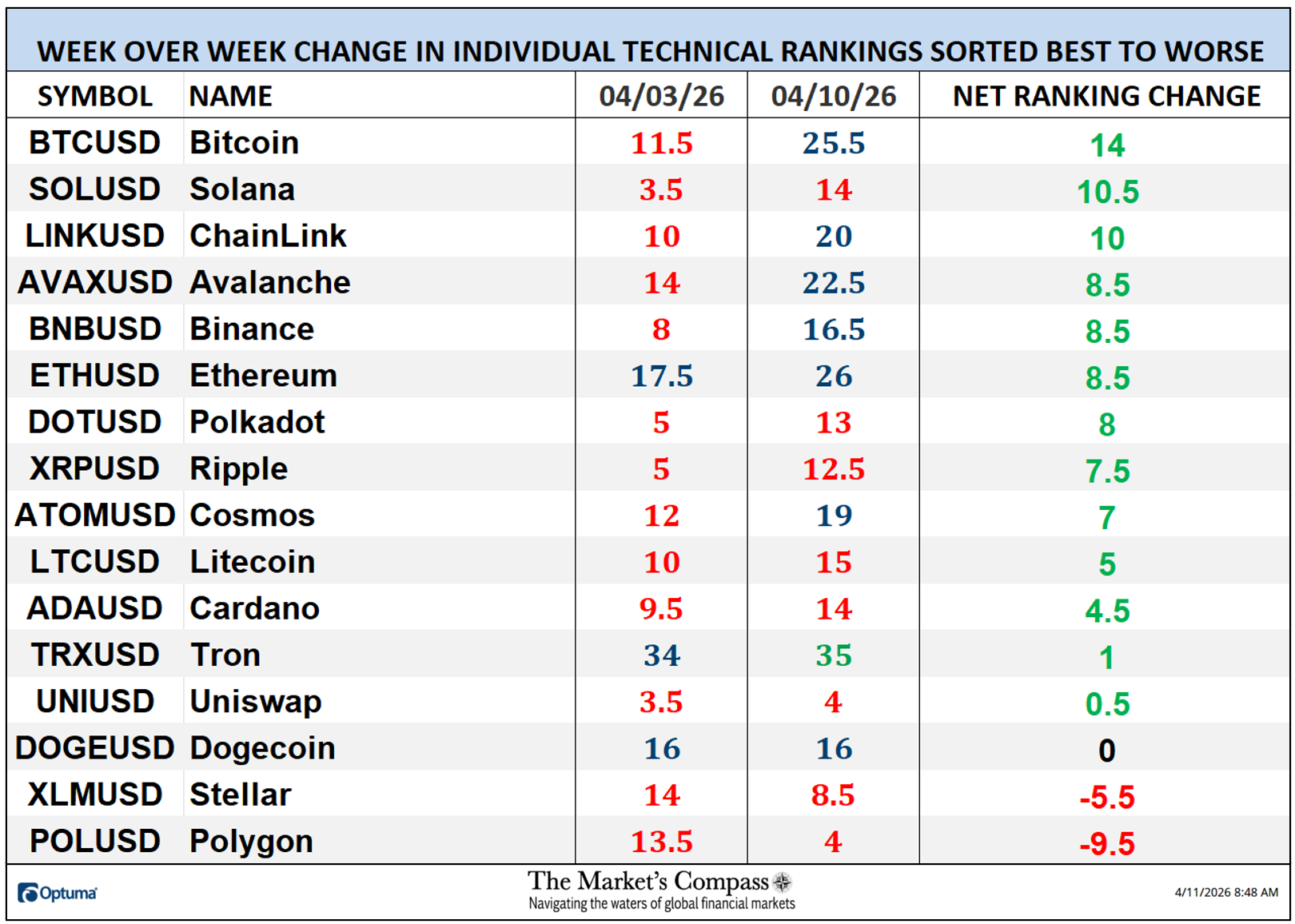
Last week eight Crypto TRs remained in the “red zone” (TRs between 0 and 15) but, four rose out of the “red zone” where they were the previous week into the “blue zone” (TRs between 15.5 and 34.5) last week making it a total of seven in the “blue zone”. Tron (TRX) returned to the “green zone” last week and at 34 it registered the best Technical Ranking of the Sweet Sixteen. The average TR gain on the week was +4.91, adding to the week before when the Average TR registered a gain of +1.91.
The Relative Rotation Graph, commonly referred to as RRGs, was developed in 2004-2005 by Julius de Kempenaer. These charts are a unique visualization tool for relative strength analysis. Chartists can use RRGs to analyze the relative strength trends of several securities against a common benchmark, (in this case the CCi30 Index*) and against each other over any given period (in the case below, daily) over the past two weeks. The power of RRG is its ability to plot relative performance on one graph and show true rotation. All RRGs charts use four quadrants to define the four phases of a relative trend. The Optuma RRG charts rotates from Leading (in green) to Weakening (in yellow) to Lagging (in pink) to Improving (in blue) and back to Leading (in green). True rotations can be seen as securities move from one quadrant to the other over time. This is only a brief explanation of how to interpret RRG charts. To learn more, see the postscripts and links at the end of this Blog.
*The CCi30 Index is a registered trademark and was created and is maintained by an independent team of mathematicians, quants and fund managers lead by Igor Rivin. It is a rules-based index designed to objectively measure the overall growth, daily and long-term movement of the blockchain sector. It does so by indexing the 30 largest cryptocurrencies by market capitalization, excluding stable coins (more details can be found at CCi30.com).
The chart below has two weeks, or 14 days, of relative data points vs. the benchmark, deliniated by the dots or nodes. Not all of the Sweet Sixteen are plotted in this RRG Chart. I have done this for clarity purposes. Those which I believe are of higher technical interest remain.
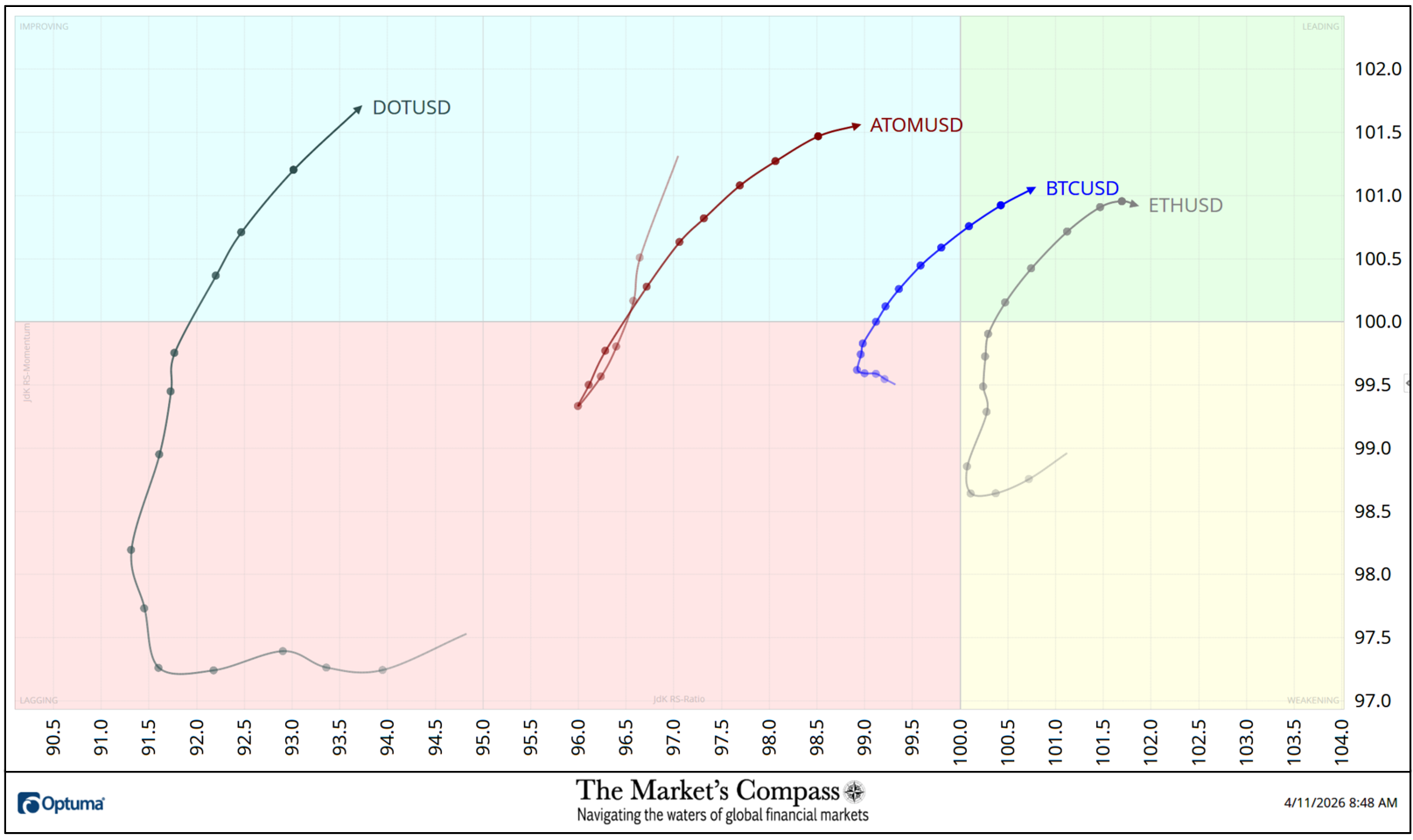
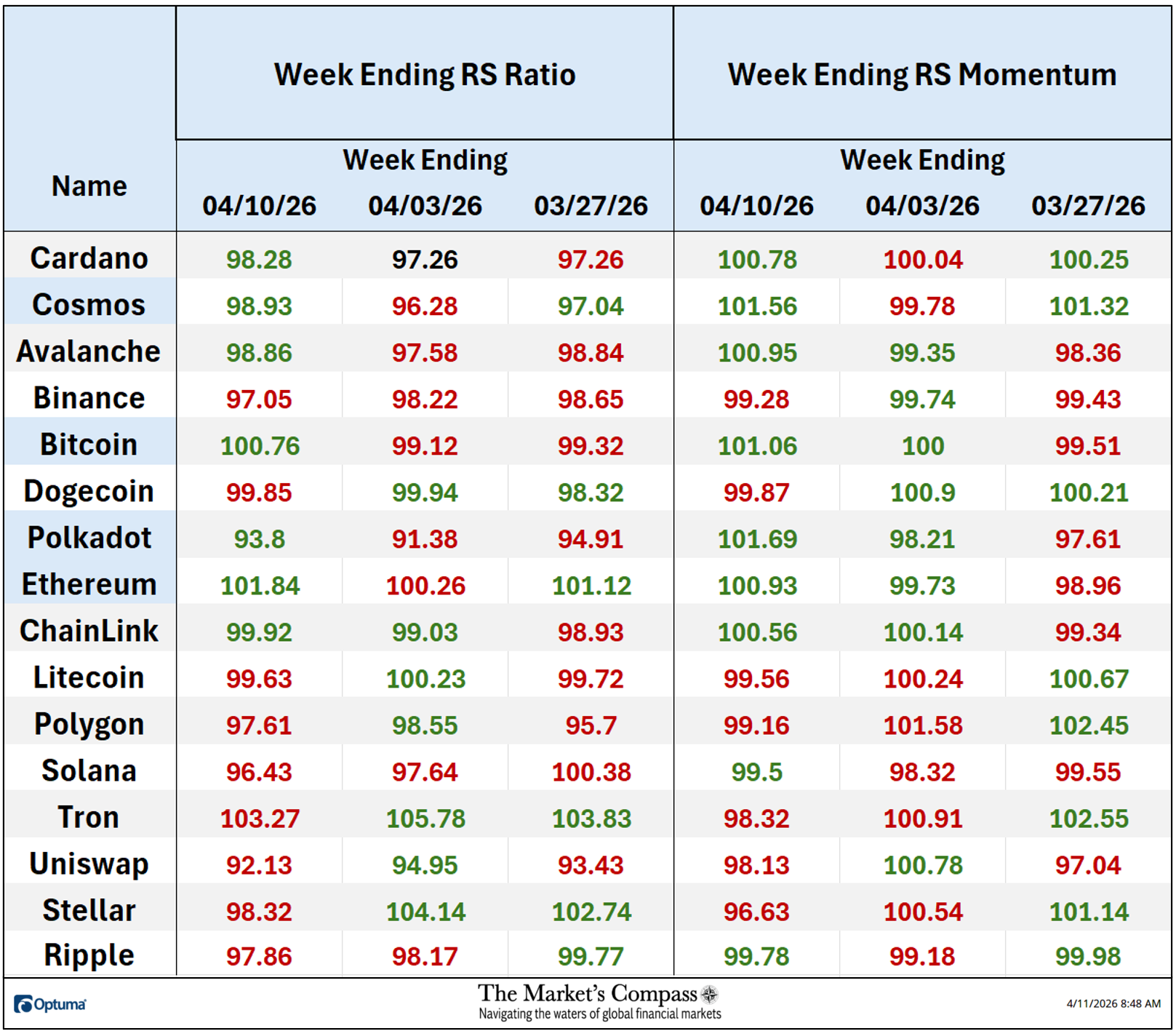
On a Relative Strength and Relative Strength Momentum basis both Bitcoin (BTC) and Ethereum (ETH) have risen into the Leading Quadrant. This is a deviation from the norm. Both often rotate around the center of the four Quadrants as they both carry an outsized weighting in the CCi30 Index at 27.68% and 11.67% respectively. Near the end of last week, they were both climbing higher in the Leading Quadrant. As will be seen later in this week’s study, both led the Sweet Sixteen higher registering absolute weekly percentage gains of +9.00%. Polkadot (DOT) logged the best Relative Strength Momentum last week (see the Tabulation Table below) as it escaped the Lagging Quadrant by rising into the Improving Quadrant. After falling precipitously into the Lagging Quadrant two weeks ago Cosmos (ATOM) made an abrupt U-turn higher and has been rising in the Improving Quadrant.
The “Tabulation Table” below marks the Relative Strength and Relative Strength Momentum readings of the Sweet Sixteen vs. the CCi30 Index at the end of last week and the two preceding weeks. If there has been an improvement in either the Relative Strength Ratio or the Relative Strength Momentum reading since the preceding week, I have highlighted it in green. If there has been a contraction in either it is highlighted in red and an unchanged reading in either will remain black. The color-coding system has served as a heat map over the past three weeks highlighting either the continued improvement, deterioration, or stasis vs. the benchmark CCi30 Index. The crypto currencies that are in the comments below the RRG chart are highlighted in blue.
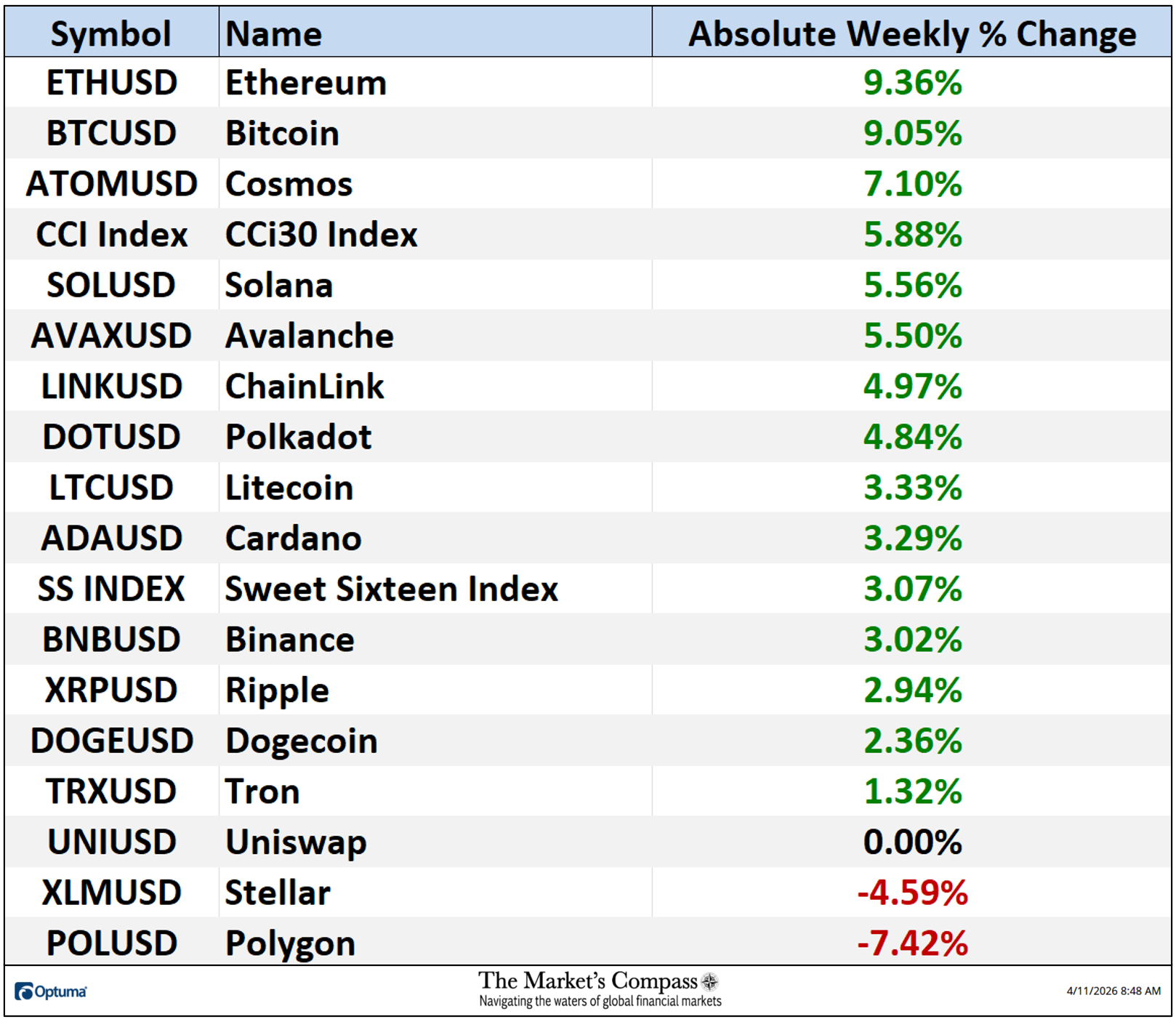
*Friday April 3rd to Friday April 10th
Last week thirteen of the Sweet Sixteen marked absolute gains (two were highlighted in the RRG discussion above), one was unchanged, and two lost absolute ground. The previous week (I did not publish the Crypto Sweet Sixteen due to the Easter Holiday), nine marked absolute gains and seven lost absolute ground. Last week the average absolute percentage gain was +3.16% vs. an average percentage loss the week before of -0.55%. Both weekly average gains and losses exclude the two Indexes.
The Technical Condition Factors or TCFs are utilized in the calculation of the Individual Crypto Currencies Technical Rankings. What is shown in the excel panel below is the total TCFs of all sixteen TRs. A few TCFs carry more weight than the others, such as the Weekly Trend Factor and the Weekly Momentum Factor in compiling each individual TR of each of the 16 Cryptocurrencies. Because of that, the excel sheet below calculates each factor’s weekly reading as a percentage of the possible total.
A full explanation of my Technical Condition Factors go to www.themarketscompass.com. Then go to the MC’s Technical Indicators and select Crypto Sweet 16.
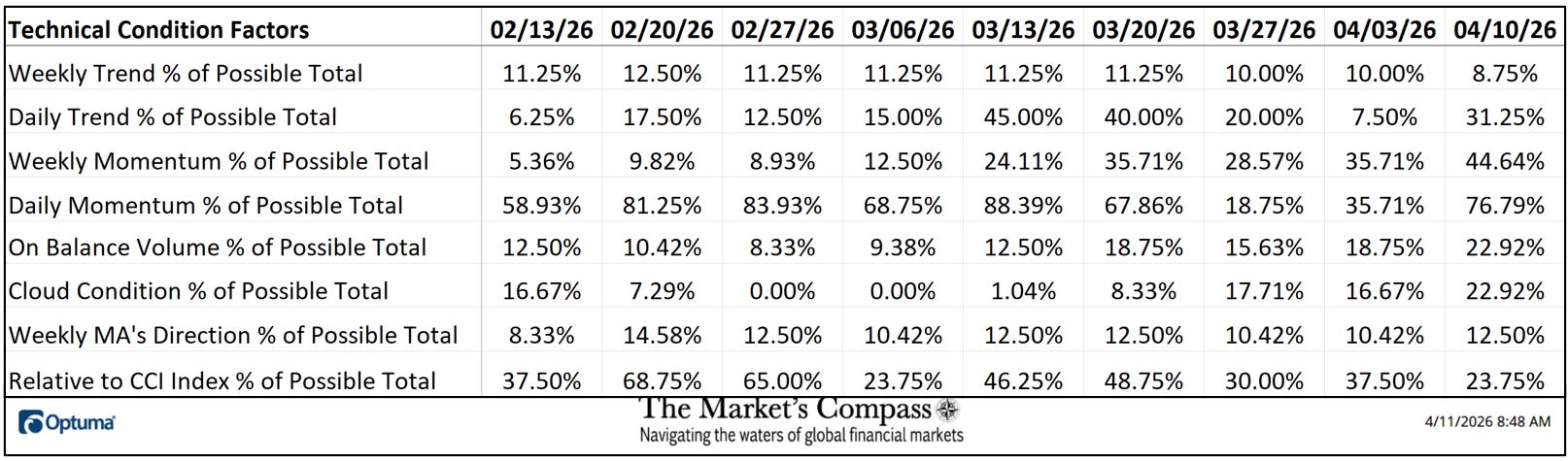
For the second week in a row the Daily Momentum Technical Condition Factor or “DMTCF” rose last week to 76.79% or 86 out of a possible 112. That was a rise from the week before reading of 35.71% or 40 out of a possible 112 and 18.75% or 21 three weeks ago.
As a confirmation tool, if all eight TCFs improve on a week over week basis, more of the 16 Cryptocurrencies are improving internally on a technical basis, confirming a broader market move higher (think of an advance/decline calculation). Conversely, if more of the TCFs fall on a week over week basis, more of the “Cryptos” are deteriorating on a technical basis confirming the broader market move lower. Last week three TCFs fell and five moved higher.
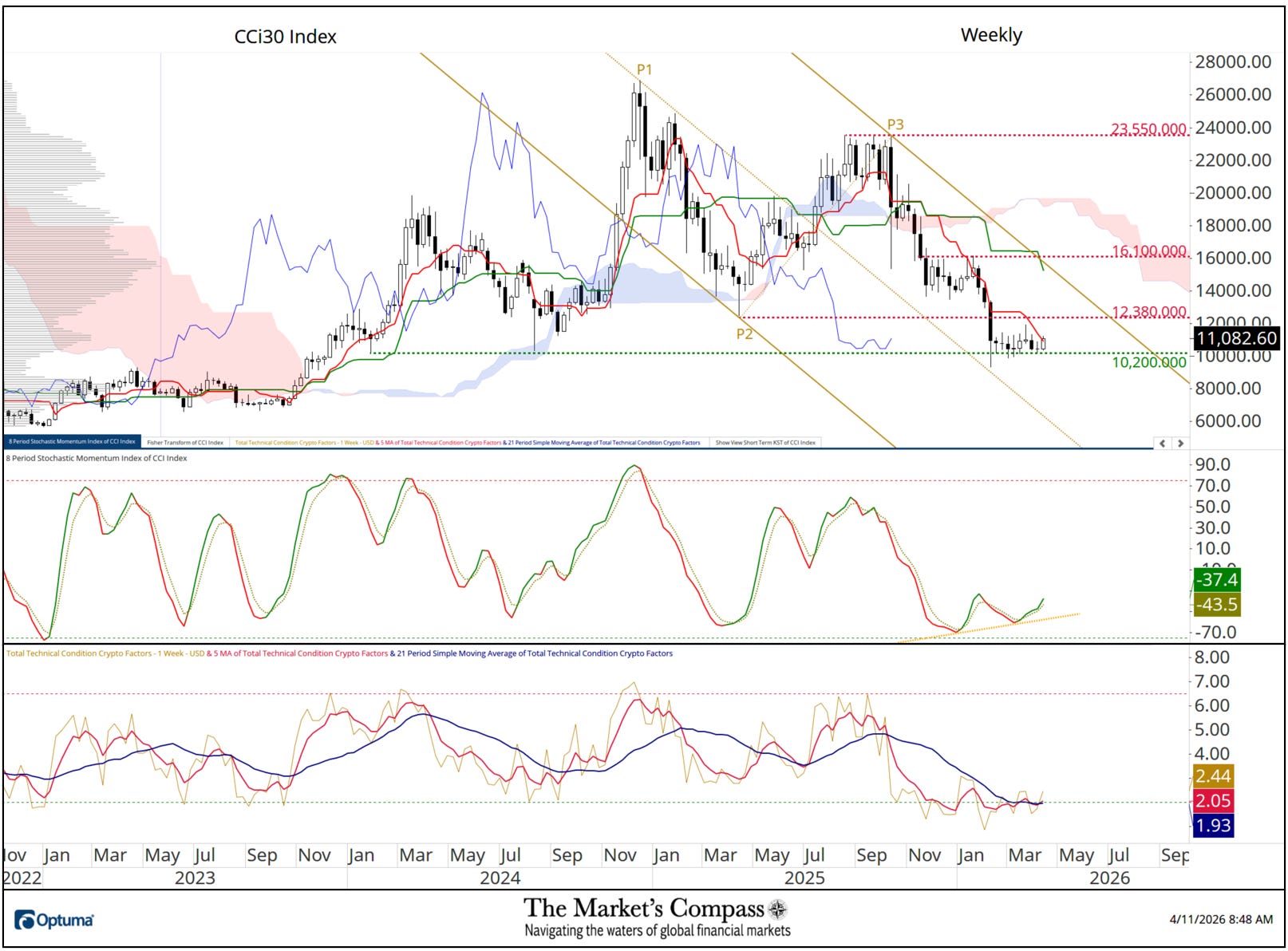
When I last wrote on my technical opinion regarding the Weekly Chart of the CCi30 Index two weeks ago, I complained that there was nary a hint in the price action to conclude that the price action was distribution or consolidation prior to a reversal. That conclusion, I’m afraid, remains unchanged despite its ability to hold above key price support. That said there are signs of hope in the secondary oscillators. The 8-Week Stochastic Momentum Index (center panel) has turned at a higher low (yellow dashed line) and is tracking above its signal line. Although the Total Sweet Sixteen Technical Condition Factor has not moved back into oversold territory and is back above both moving averages, it will need to move above its January highs to convince me that something more positive is building.
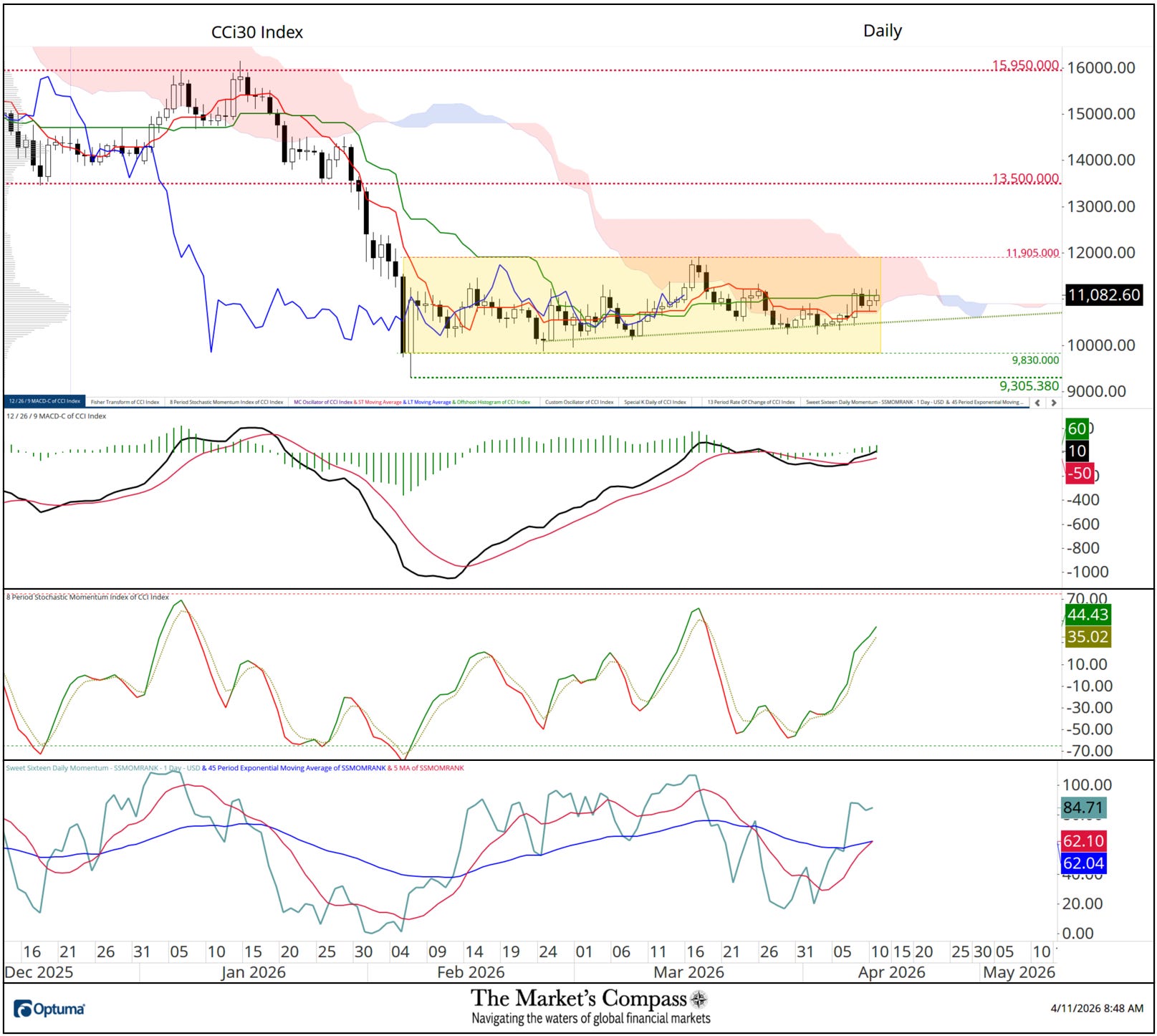
The CCi30 Index remains range bound mired in the box between key support at the 9,830 level, and resistance at the11,905 level. Last week the index edged its way back into the Cloud but has been capped by the Kijun Plot (green line). On a daily closing basis, the index has held support offered by the gently rising price trend (green dotted line). Longer-term MACD is climbing again, is above its signal line and has turned positive. The shorter-term 8-Day Stochastic Momentum Index has risen from a higher low and is tracking higher above its signal line (center panel). The Sweet Sixteen Daily Momentum / Breadth Oscillator has pushed above the now rising 45-Day Exponential Moving Average and the shorter-term 5-Day SMA (red line) is set to cross above the longer-term EMA. These are positive short-term secondary technical features but as I said two weeks ago “in price there is truth”, and there is not yet enough to hang a “bullish hat on”.
For readers who are unfamiliar with the technical terms or tools referred to in the comments on the technical condition of the CCi30 Index can avail themselves of a brief tutorial titled, Tools of Technical Analysis available on my website.
Charts are courtesy of Optuma whose charting software allows the Technical Rankings to be calculated and back tested.
To receive a 30-day trial of Optuma charting software go to…